

Last Updated: November 17, 2026
Quick Summary
To prevent backyard erosion, redirect water before you repair soil: find the uphill source such as a downspout or compacted path, then fix the cause so the symptom stops returning. Add downspout extensions, swales, and dense native planting, and match slope methods to your grade.
- Rills are shallow channels a few centimetres deep that return with each storm.
- Ground should slope away from the foundation roughly 2 centimetres per 30 centimetres of run.
- Build terraces from the lowest level first and never from the top down.
- Clean gutters twice a year so overflow does not soak the ground below.
- Apply a 5 to 8 centimetre layer of erosion control mulch on gentle slopes and beds.
Table of Contents
- Find the Root Cause Before You Fix Anything
- How to Stop Soil Erosion on a Slope
- Backyard Drainage Solutions That Move Water Away
- Best Plants for Erosion Control and Ground Cover
- Erosion Control Mulch and Blankets: When to Use Each
- Retaining Walls, Permits, and When to Call a Professional
- Frequently Asked Questions
Find the Root Cause Before You Fix Anything
Water always wins when a yard has nowhere to send it. That is the heart of how to prevent backyard erosion: redirect water before you repair soil.
Erosion rarely starts where you see the damage. It starts uphill, at a downspout, a compacted path, or a slope that sheds water toward the house. Fix the cause and the symptom stops returning.
Reading the Signs: Rills, Gullies, and Sediment
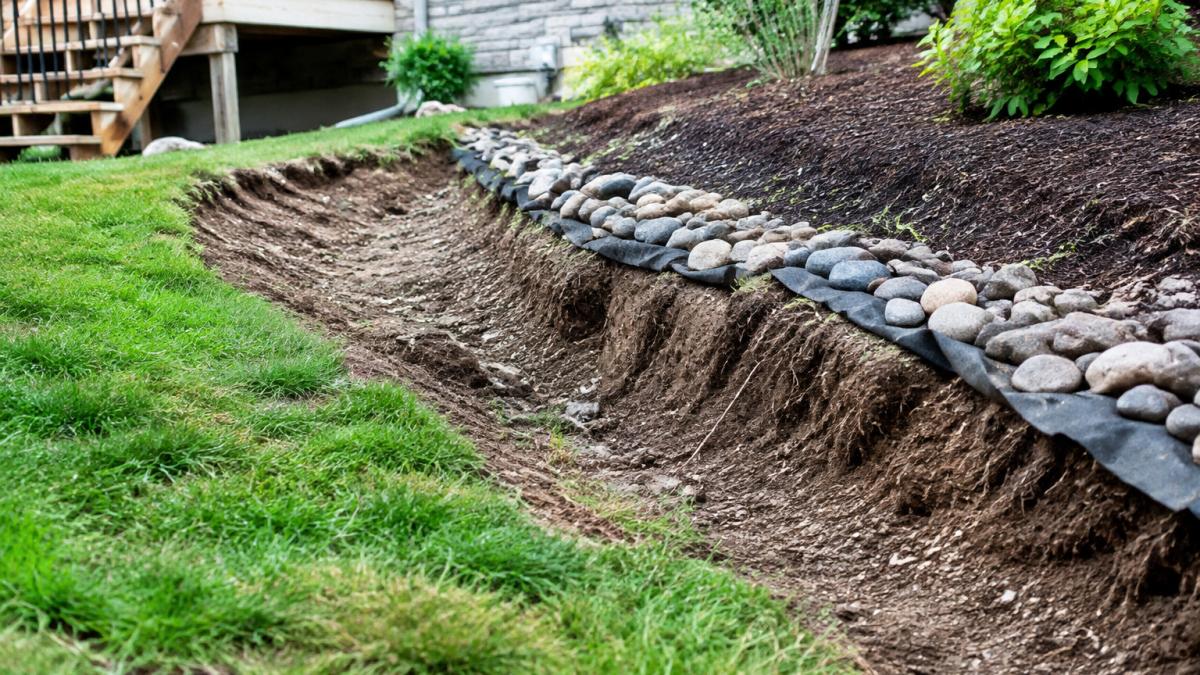
Backyard erosion is the gradual loss of topsoil and subsoil caused by water or wind moving across unprotected ground. The damage tells you how far along the problem is:
- Rills are shallow channels a few centimetres deep. They vanish after rain and return with the next storm.
- Gullies are deeper cuts that survive dry weather. They need structural repair, not raking.
- Sediment fans at the fence line or driveway edge show where soil is landing. Trace them uphill to find the entry point.
A common mistake is filling a gully with fresh topsoil and stopping there. The next heavy rain reopens it within weeks.
Test Your Soil and Check Your Grading
Soil composition decides how fast water soaks in. Clay-heavy soil sheds almost everything, while sandy loam absorbs far more.
Grading matters just as much. Ground should slope away from the foundation, roughly 2 centimetres per 30 centimetres of run.
If your yard has repeated flooding near the foundation, a professional design plan is often cheaper than repeated repairs. Our team explains how expert planning prevents drainage and layout mistakes.
How to Stop Soil Erosion on a Slope
Slope stabilization comes down to slowing water down and shortening the distance it travels before it soaks in. Break the slope into shorter runs, cover the soil, and remove water arriving from above.
Match the Method to the Grade
Slope angle dictates which methods will actually hold. Slopes are commonly sorted into three bands:
- Gentle grades (under about 10 percent, roughly 1 metre of rise per 10 metres of run): dense vegetation, mulch, and contour planting are usually enough.
- Moderate grades (about 10 to 25 percent): terracing, erosion control blankets, and shallow swales are needed to break up flow length.
- Steep grades (over about 25 percent): structural reinforcement such as retaining walls, riprap, or engineered terraces is often required, and a professional assessment is prudent.
Measure the grade by holding a level 1 metre long with one end on the slope and measuring the vertical gap at the other end. A 25 centimetre drop over 1 metre is a 25 percent slope.
Terracing and Contour Planting
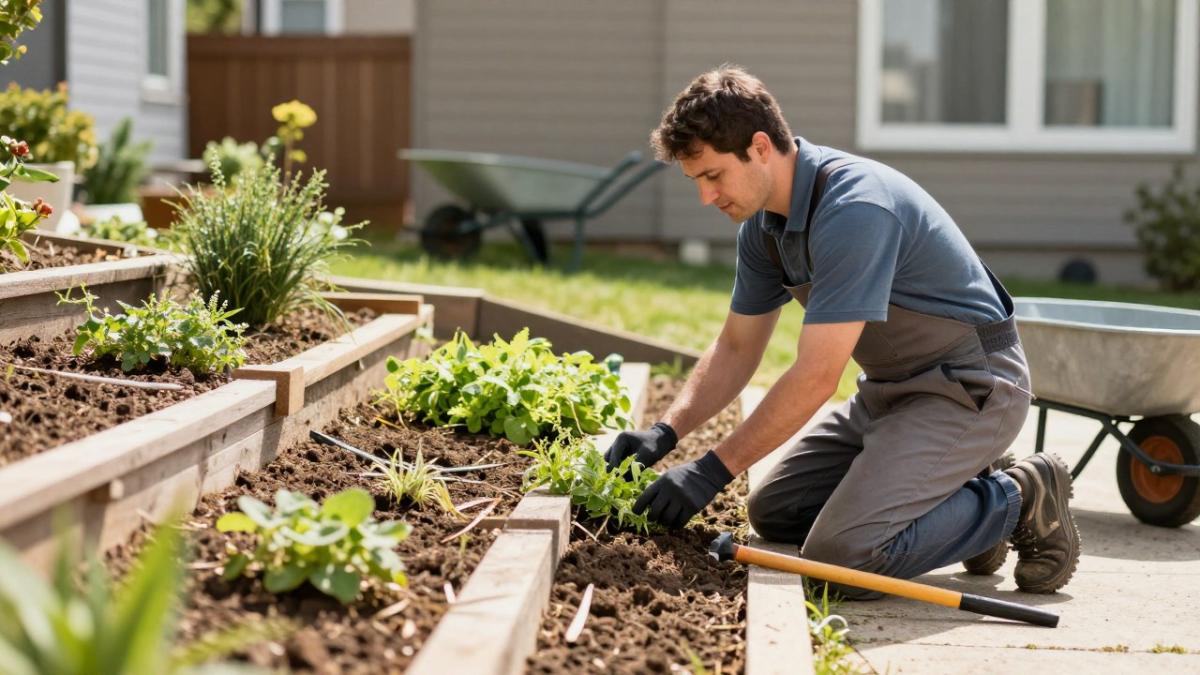
Terracing cuts a long slope into flat steps, slowing runoff and giving water time to soak in. Timber, stone, or block retain each level.
Contour planting works on gentler grades. Plant across the slope instead of in straight rows up and down the hill; roots form natural barriers that catch soil.
Follow this order:
- Mark the contour lines with stakes and string
- Build the lowest terrace first
- Add topsoil and pack it lightly
- Plant immediately so bare soil is never exposed
- Mulch every terrace edge
Watch out: building terraces from the top down concentrates water on unfinished lower levels and can trigger a slump; always work uphill.
Intercept Water Above the Slope
Most slope erosion starts with water entering the slope from above, not rain falling on it. A swale or diversion ditch at the top of the slope, graded to a safe outlet, removes that water before it reaches the face. Where the upslope area belongs to a neighbour or municipal reserve, the diversion may need to sit on your side of the property line, so confirm the boundary before digging.
Reinforce Where Vegetation Cannot Hold
Vegetation alone will not hold a steep, saturated slope. Where the grade exceeds what roots can bind, use structural reinforcement: riprap on channel edges and outlets, geotextile under gravel to let water pass while holding soil, and engineered retaining structures where the slope surcharges a foundation, driveway, or pool.
If your yard has repeated flooding near the foundation or a slope that keeps failing after every repair, a professional design plan is often cheaper than repeated fixes. Our team explains how expert planning prevents drainage and layout mistakes.
Backyard Drainage Solutions That Move Water Away
The best backyard drainage solutions move water somewhere safe instead of letting it pool. Standing water softens soil, undermines structures, and keeps the erosion cycle going.
A drainage system can be simple or layered:
- Surface grading to steer water across the yard
- Swales, shallow grass-lined channels that carry runoff
- French drains, gravel-filled trenches with perforated pipe
Downspout Extensions and Gutter Maintenance
A downspout that dumps beside the foundation is one of the most common causes of backyard erosion.
Clean gutters twice a year. Blocked gutters overflow at the roofline and soak the ground below.
Watch out: extending a downspout into a spot that already holds water just moves the puddle. Aim the outlet at a graded path or a dry well.
Best Plants for Erosion Control and Ground Cover
The best plants for erosion control hold soil with dense root systems. Deep, matted roots bind soil particles and slow surface water better than turf alone.
Native plants are the strongest choice. They suit local rainfall and soil and need less care once established. Good options include native grasses, sedges, creeping juniper, and low shrubs with fibrous roots.
Vegetative cover works in layers:
- Ground cover for bare patches and slope faces
- Grasses for fast root establishment
- Shrubs for structure and windbreaks
Plant densely. Sparse planting leaves soil exposed between stems, and that is where rills begin.
Erosion Control Mulch and Blankets: When to Use Each
Erosion control mulch protects soil surface while plants establish. A 5 to 8 centimetre layer cushions raindrop impact, slows runoff, and holds moisture.
Use mulch on gentle slopes and landscape beds. Use erosion control blankets on steeper ground or where seed needs protection.
| Material | Best For | Slope Limit | Notes |
|---|---|---|---|
| Organic mulch | Beds, gentle slopes | Low | Reapply yearly |
| Erosion control blankets | Seeded slopes | Moderate to steep | Pin edges firmly |
| Geotextiles | Under gravel and riprap | Steep | Let water pass, hold soil |
| Riprap | Channel edges, outlets | Steep | Stone absorbs energy |
| Hydroseeding | Large bare areas | Moderate | Fast, even coverage |
Landscape fabric belongs under gravel paths and stone, not on open soil. It blocks water and can worsen runoff.
Retaining Walls, Permits, and When to Call a Professional
A retaining wall holds soil back and manages grade change. It is structural, not decorative. Under-built walls lean, crack, and sometimes fail after a freeze-thaw winter. The two questions homeowners ask most are whether they need a permit and whether the job is still a DIY project.
Permit Requirements: What to Confirm Before You Dig
Permit rules are set by the local municipality, and thresholds vary. Permit requirements vary by municipality, and thresholds differ. Confirm the rules that apply to your property with your local building department before building.
Before building, confirm four things with your local building department:
- The maximum retained height allowed without a permit
- Whether engineered drawings are required and who must stamp them
- Setback requirements from property lines and from any slope or watercourse
Watch out: a wall built without a required permit can be ordered removed at the owner’s cost and can complicate a future property sale; confirm the threshold with your local building department before building.
DIY vs. Professional: A Decision Framework
Use this matrix as a general guide to whether the job is within DIY reach or needs a professional:
| Situation | Typical path |
|---|---|
| Wall under about 0.6 metres, well drained, no surcharge | Experienced DIY is often feasible |
| Wall 0.6 to 1 metre, or any wall with a permit requirement | Professional design and build recommended |
| Wall over 1 metre, or any wall surcharging a driveway, pool, or foundation | Structural engineer and permitted build required |
| Visible leaning, bulging, or cracks wider than a pencil line | Professional assessment before any repair |
| Water pooling behind an existing wall | Drainage correction by a professional |
| Slope failure near a foundation or pool | Immediate professional assessment |
The threshold is not just height. A low wall carrying a driveway or holding a saturated slope carries far more load than its height suggests, and those are the cases where DIY failures are most expensive.
Material Trade-Offs Over the Long Term
Material choice affects lifespan, maintenance, and total cost more than any other decision:
- Timber walls suit low garden terraces and blend into planting. They have the shortest lifespan of the common options and typically need replacement sooner than masonry, so the lower upfront cost is offset by earlier replacement.
- Interlocking block walls handle taller grades and last decades with minimal maintenance. Higher upfront cost, but the longest service life of the common residential options.
- Poured concrete walls offer high strength and long life but need formwork and curing time, and they are less forgiving of settlement than segmental block.
Compare total cost over the expected service life, not just the build price.
You can see the options on our retaining walls for sloping backyards page, compare wooden retaining wall construction, or explore interlocking retaining wall systems.
Call a professional when you see any of these:
- A wall leaning or bulging outward
- Cracks wider than a pencil line
- Water pooling behind a wall
Our landscaping contractors team handles design, permits, and build in one process.
Spring flooding near your foundation will not fix itself, and patching the same washout every year costs more than solving it once.
Frequently Asked Questions
What is the best way to prevent erosion in a backyard?
There is no single fix. Start by finding the cause: compacted soil, a badly graded slope, or a downspout dumping water next to the foundation. Then combine three things: redirect water away from the house, cover bare soil with plants or mulch, and stabilize any slope with terracing or a retaining wall. Backyard erosion usually comes back when only one of those is addressed.
How do I stop soil from washing away on a slope?
Slow the water before it gains speed. Terrace the slope or plant on the contour so each row catches runoff, then add deep-rooted native plants and erosion control mulch or netting until the cover establishes. For steep drops or slopes holding up a structure, a properly designed retaining wall with drainage behind it is the durable answer. Taller walls often need engineered drawings and a permit, so check with your local building department.
Does mulch help control soil erosion?
Yes, if it is the right kind and applied thick enough. A 5 to 8 cm layer of coarse erosion control mulch cushions raindrop impact and slows surface flow, which keeps topsoil in place while new plants establish. On steeper ground, tackifier-treated mulch, erosion control blankets, or coir netting hold better than loose bark mulch alone.
When should I call a professional about yard erosion?
Call a professional when water is pooling against the foundation, when a slope shows deep gullies or exposed roots, when a retaining wall is leaning or bulging, or when the fix touches grading, drainage connections, or structures. Those cases involve structural integrity and local permit rules, and a wrong DIY repair often costs more to undo than doing it right the first time.
